I’ve seen many of my friends getting confused between bushcraft and survival knives. They use these two terms interchangeably and they buy the wrong one and I had to explain their differences so that they can pick the right one.
As a hunter, I’ve used both of them in the last 18 years. I pick the right one depending upon my purpose and I’ll discuss that in a minute.
The Main Differences
The major differences are their blade length and shape. A survival knife features longer and broader blades to perform heavy tasks like batoning whereas a bushcraft knife would have a scandi edge to perform activity like starting a fire.
Let’s talk about the key differences in detail.
1. Purpose
Purpose is the most differentiating factor between these two knives.
If you have been dropped by the military, checking your endurance for a tough wilderness environment, lost in a trekking camp, you need a survival knife. You need it to stay alive by doing things like building a shelter, building traps, facing dangerous animals, etc.
It’ll be the only tool with you to protect yourself in such situations. The only goal with this knife is, survive and get out of the woods as soon as possible. I’ve been in such situations a couple of times and I have carried this knife to protect and survive myself.
Bushcraft, as the name suggests, is going out in the woods or jungle purposefully for camping, hiking, cooking and having a relaxed time. You need this knife for food preparation, cutting saplings, making tools and more. It is an additional tool in your outdoor camping kit along with saw, axe, jackknife and more.
When I plan to go camping or hiking with my friends, I go with the Bushcraft as it is easy to carry and operate.
2. Strength
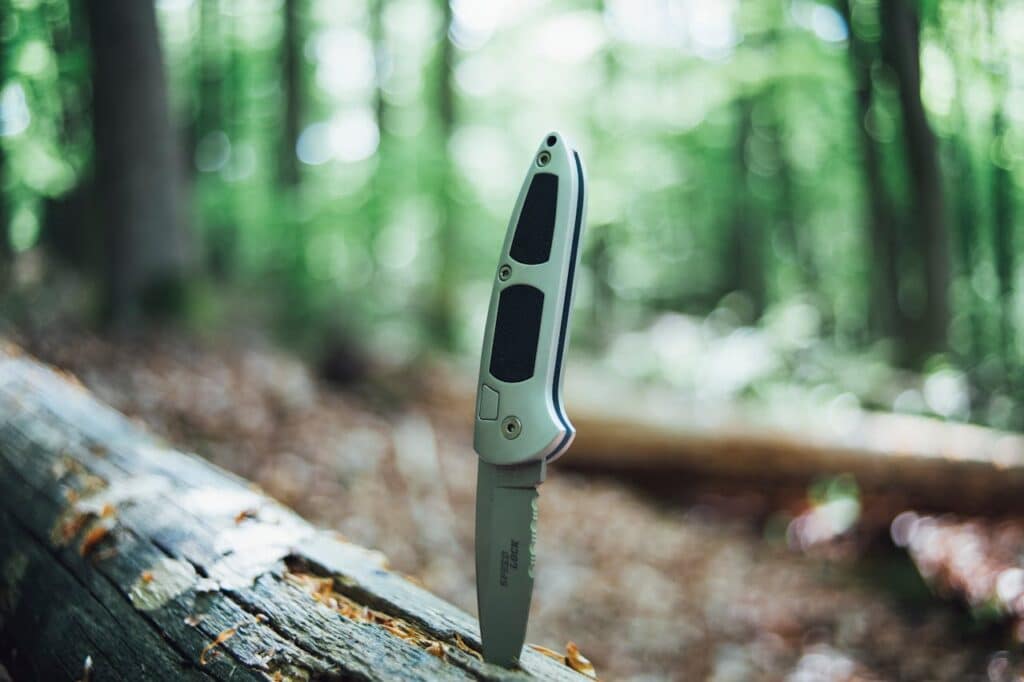
The strength of a survival knife is significant because you aren’t playing outdoors for fun; your life depends on it. During an emergency, this knife should be able to perform tasks such as carving, skinning, batoning, or defending yourself against dangerous animals. To perform such tasks, the thickness should be at least 4mm.
This knife with a wooden handle isn’t recommended because it may break easily. Instead, I go with materials like G10, Micarta because it will help the knife last longer while surviving outdoors.
Having a bushcraft knife with decent strength is fine because you will be doing less demanding tasks like cutting ropes, opening boxes, chopping dead branches, food preparation, etc. For these tasks, you need a knife with a 1.4mm to 3.1mm thickness, and a wooden handle would be just fine. Most of my bushcraft knives are in this range and are sufficient to perform any task easily.
3. Ergonomics
Bushcraft tops in ergonomics because they are usually lightweight and have smaller blades. Due to larger and wider blades, survival knives may not be as ergonomic as a bushcraft.
Survival knives usually come with a fixed blade as it holds up better during emergency situations. Bushcraft also comes mostly with a fixed blade however, opting for a folding blade may not do any harm to you as you can easily carry it anywhere you want.
4. Knife size
The average size of a survival knife is 4 inches and it can go up to 7 inches. These longer blades are essential to perform heavy tasks.
The average size of a bushcraft knife is 3.5 inches and can go up to 5 inches. This blade length is good enough to perform most bushcraft tasks. The thickness of these knives are about 2.5mm to 4mm.
Still want to know more about the differences between these two knives? Watch this video.
Examples
1. Bushcraft- Condor Bushlore
Blade Length: 4.3-inches
Blade Thickness: 3mm
Overall Length: 9.3-inches
Steel: 1075 High Carbon Steel
Handle Material: Walnut
Weight: 0.38 lbs
This knife features a drop-point blade and a full tang. It has a scandi grind which is helpful to perform tasks like carving and they are easy to sharpen.
The steel has excellent edge retention, toughness but it can easily. You need to protect the knife every once in a while by cleaning and oiling. It is extremely lightweight to carry in the woods and has decent blade size to perform most outdoor tasks. It is priced well at $62.
I’ve owned this knife for more than 5 years and it is my go to choice whenever I go outdoors for fun with my friends.
2. Survival Knife- Cold Steel Recon Scout
Blade Length: 7.5-inches
Blade Thickness: 8mm
Overall Length: 12.5-inches
Steel: CPM 3V
Handle Material: Kray-Ex
Weight: 0.96 lbs
It features a clip-point blade and a full tang. The robust blade is equipped with semi-stainless steel, the CPM 3V has 7.5% chromium and good wear resistance and toughness. It also comes with a sheath to protect the knife when not using it.
These properties are well suited to help in survival situations and it is a well-priced knife at $218.
When I plan to go into the wilderness for hunting, I bring this knife to protect myself from any dangers.
FAQs
1. Is stainless steel good for a bushcraft knife?
Yes. It has excellent corrosion resistance and edge retention suitable for outdoors. However, sharpening this steel isn’t very easy.
2. Can a bushcraft knife be used for hunting?
Yes. It can be used for hunting however, you may not be able to do heavy-demanding tasks like skinning, gutting etc with this knife.
3. What are the requirements for a survival knife?
It should have at least 4-inches fixed blade and minimum thickness of 2.5mm. It must feature a high-quality steel with good corrosion resistance, wear resistant and easy to sharpen.
4. What type of knife is best for bushcraft?
A bushcraft knife should feature a 3-5 inches fixed blade with a scandi grind, full tang and high-quality steel that is able to withstand harsh weather for durability.
5. Are bush knives good for survival situations?
Yes, they are good options for these situations as they are lightweight and the drop-point blades are helpful to perform many tasks like carving, skinning, field dressing, building shelter, starting a fire etc.
6. What is a good thickness for a bushcraft knife?
It should have a thickness of 3mm to 4mm.
Conclusion:
Choosing the right knife between these two isn’t a difficult task. If you want to spend some time with your friends in the woods, bushcraft knives along with other essential items would be just fine for you. If you end up in a survival situation during a military training or similar activities, you must go with the survival knife.
Still have any questions? Drop them in the comments and I’ll get back to you as soon as possible. Cheers!